
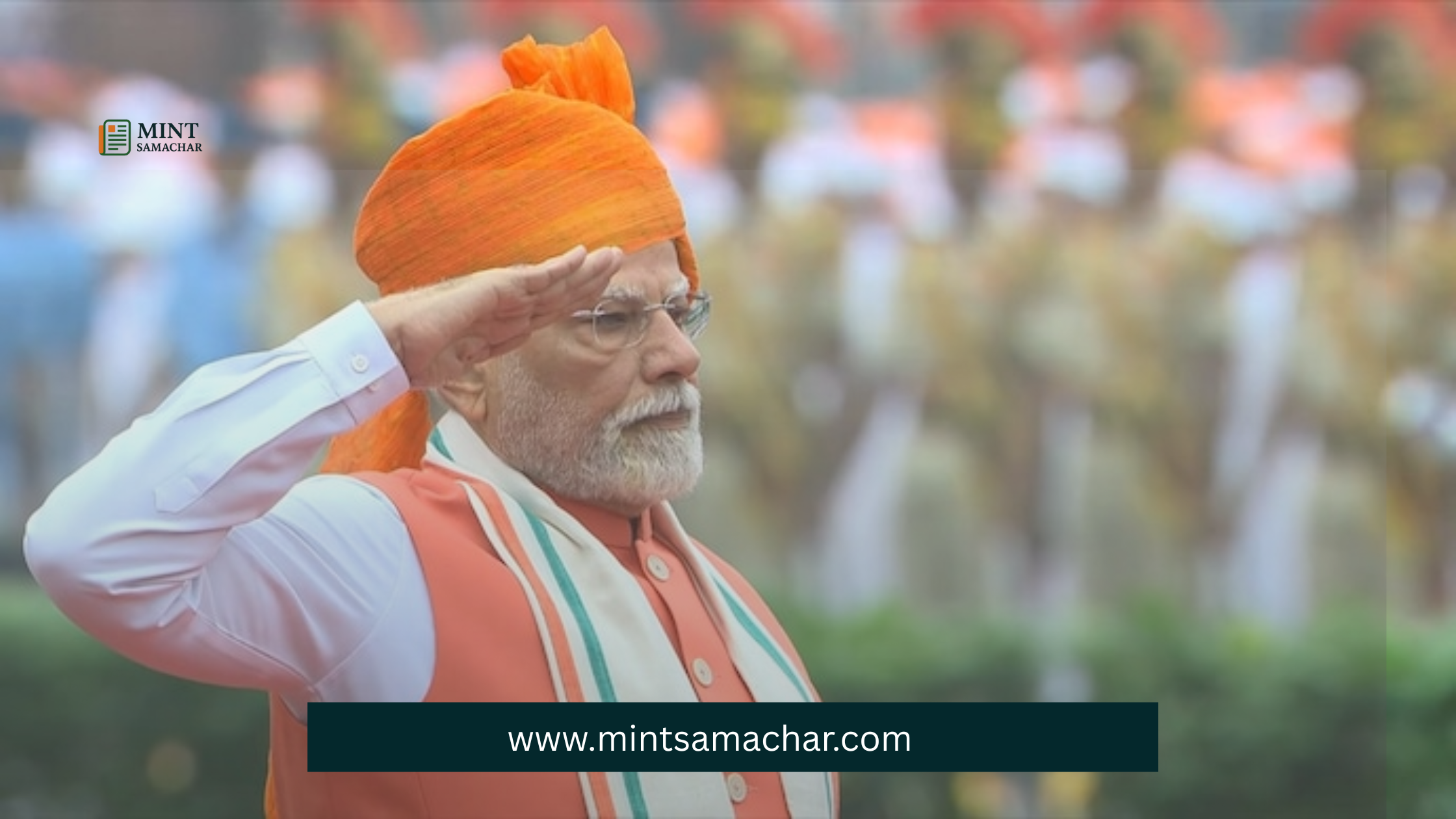
New Delhi, August 15, 2025 — From the historic ramparts of the Red Fort, PM Modi’s 15 August 2025 Speech delivered a 79th Independence Day address that blended a vision for a self-reliant India with concrete measures to boost defence, the economy, and technological growth. The nearly 90-minute speech outlined new policies, reaffirmed existing commitments, and projected a roadmap to transform India into a developed nation by 2047.
A Vision Anchored in Self-Reliance – PM Modi’s 15 August 2025 Speech
Opening his address with a tribute to the freedom fighters who secured India’s independence in 1947, PM Modi stressed that “Viksit Bharat” (Developed India) will only be achieved through Atmanirbharta (self-reliance). “The journey to 2047 will be written by our own hands, and powered by our own capabilities,” he said, urging all sections of society — from farmers to entrepreneurs — to contribute.
Strengthening National Defence
One of the most notable announcements was the upcoming induction of the ‘Sudarshan Chakra’ defence system into the armed forces. Developed entirely in India, the system is designed to bolster India’s border security and neutralize emerging threats. PM Modi emphasized that India will not tolerate terrorism or cross-border intimidation.
This announcement builds on his previous Independence Day addresses, where defence self-sufficiency was a recurring theme. In 2023, the focus was on indigenous aircraft carriers; in 2024, on locally manufactured drones. The Sudarshan Chakra represents the next step in that series.
[ruby_related heading=”More Read” total=5 layout=1 offset=5]
Economic Reforms With a Festive Deadline
On the economic front, PM Modi promised next-generation GST reforms, aiming to reduce the tax burden on essential goods and make compliance simpler for small businesses. He hinted at rolling out these changes by Diwali 2025, calling it a “festive gift” for the middle class and entrepreneurs.
The reforms are expected to impact millions of shopkeepers, traders, and service providers, potentially increasing business confidence and consumer spending ahead of the festival season.
Job Creation for the Youth
The Prime Minister also announced the Prime Minister’s Vikas Rozgar Yojana, a scheme designed to help young Indians secure their first job in the private sector. Under the plan, new employees will receive a one-time grant of ₹15,000, while companies hiring them will get targeted incentives. This initiative is positioned as a bridge between skill development and real employment opportunities, complementing existing programs like Skill India and Startup India.
Agriculture and Technology: Driving the Future
Addressing farmers, PM Modi pledged continued support in modernizing agriculture. India, he said, is making rapid progress in becoming self-sufficient in fertilizers, seeds, agricultural machinery, electric vehicle batteries, and semiconductor chip manufacturing.
The mention of semiconductor chips is particularly significant, as it aligns with India’s ambition to become a global electronics manufacturing hub. The Prime Minister said the first batch of Made-in-India chips will hit the market by the end of this year, potentially reducing dependency on imports and boosting exports.
Public and Industry Reactions
Early reactions to the speech have been mixed but largely optimistic. Business leaders welcomed the GST reform announcement, saying it could simplify tax processes and encourage small business growth. Defence experts praised the Sudarshan Chakra system as a much-needed boost to India’s strategic capabilities.
Youth organizations, while appreciative of the Vikas Rozgar Yojana, called for parallel investments in education and vocational training to ensure long-term employability. Farmer groups expressed cautious optimism, seeking clarity on how the government’s agricultural technology initiatives will be implemented on the ground.
A Look Back: Continuity and Change
Over his past ten Independence Day addresses, PM Modi has used the Red Fort platform to launch or highlight flagship initiatives — from Swachh Bharat in 2014 to Har Ghar Jal in 2019. The 2025 speech reflects continuity in his emphasis on self-reliance but also a shift towards high-tech manufacturing, defence innovation, and direct employment generation.
The Road to 2047
Concluding his speech, PM Modi reiterated his call for collective responsibility in nation-building. “This is the time to shape India’s golden future. Whatever we create today will define the India of 2047,” he said, urging the youth to innovate, farmers to modernize, and businesses to compete globally.
The speech, blending policy announcements with a long-term vision, sets the tone for the next phase of India’s development. Whether these initiatives translate into measurable outcomes will depend on execution — something the coming months and years will reveal.